San francisco, USA, September 7, 2026
AI interactive-content company Yoroll has released Yoroll H3 Superfast, its own post-trained video model, and launched YoLive, a real-time storytelling product powered by it. Together, they bring faster video generation into an experience where viewers help decide what happens next.

A new video model and a shared storytelling experience put real-time generation in the audience’s hands.
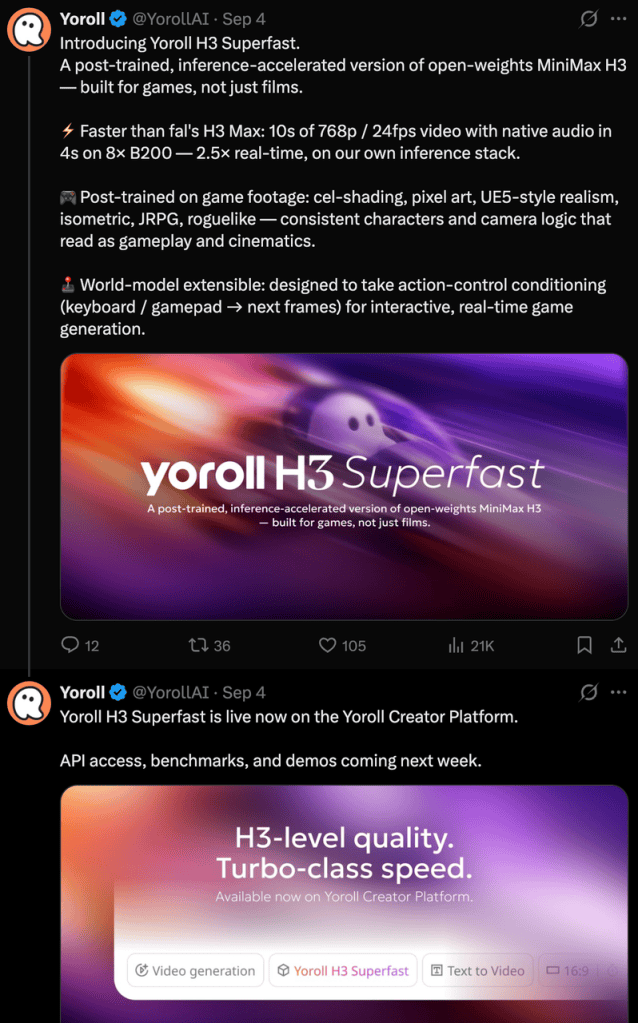
According to Yoroll’s launch announcement, Superfast generates 10 seconds of 768p video at 24 frames per second, with native audio, in four seconds on eight NVIDIA B200 GPUs. That is 2.5 times the playback rate under the reported test conditions. The figure measures clip generation; the time from a viewer’s input to an onscreen response also depends on processing and delivery.
The product opportunity is straightforward: when the next scene can be generated while the current one plays, audiences can start participating in how a story unfolds. Making that experience work requires the model, the story system and the audience’s choices to stay connected.
The audience helps write the next scene
In YoLive, viewers share a story, propose what should happen next and vote on the direction it takes. The winning proposal guides the next generated scene. A single video stream becomes a space for collective storytelling, with each decision giving the audience a reason to keep watching.
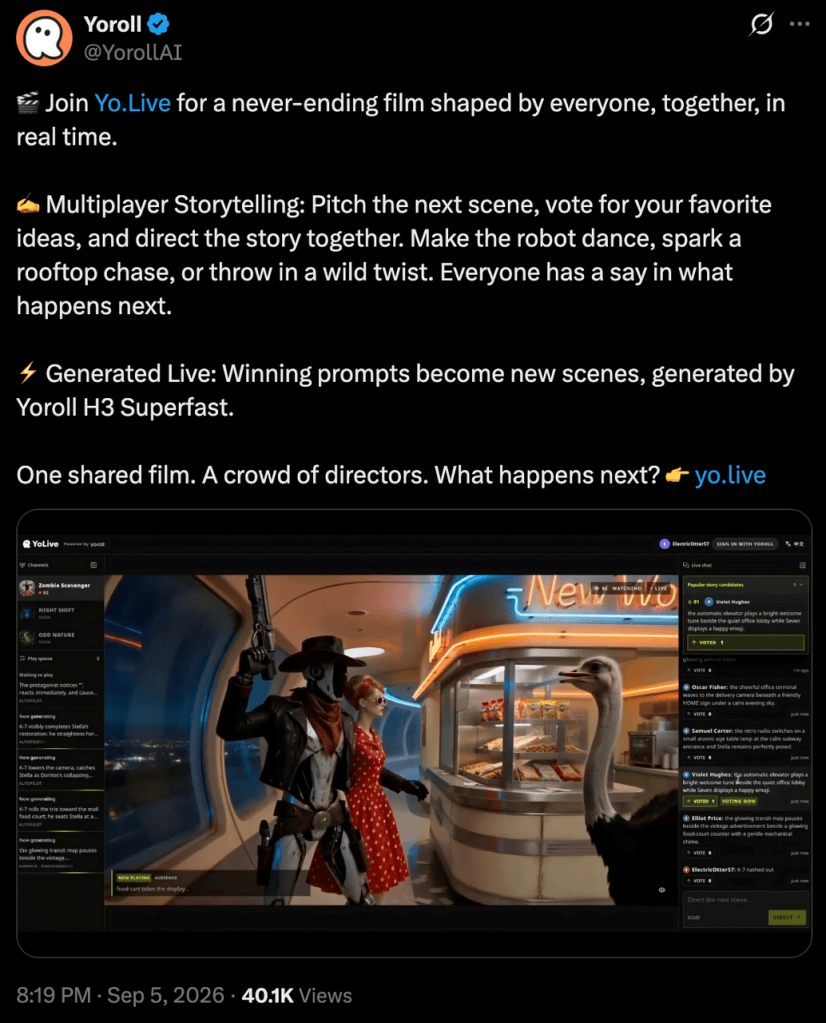
An initial channel draws on Zombie Scavenger, Yoroll’s game set in a retro-futuristic wasteland. Its characters and world give viewers a starting point for their suggestions. Familiar faces, recurring conflicts and shared decisions can turn a sequence of generated clips into a story people want to follow.
Yoroll is also developing smaller interactive experiences around the same idea. A dating game lets players guide an encounter through free-form conversation and actions. An unboxing simulator turns audience suggestions into gifts and generated reactions. A stick-figure adventure lets players propose their own ways out of trouble. Each explores a specific question: how much of the next scene can a player meaningfully change?
Built around interactive content
Superfast is based on the open-weight MiniMax H3 model and combines Yoroll’s post-training work with inference acceleration. Yoroll says its development draws on a substantial body of in-game data accumulated through building interactive video and games. The work targets the demands of those experiences, including character consistency, camera behavior and visual styles suited to different game genres.
That development sits alongside an existing content business. Yoroll’s Zombie Scavenger demo at Gamescom combined Unreal Engine shooting, idle tower defense and AI-driven narrative. The company also reports that its palace-drama mini-game Empress: Palace of Men attracted more than two million players in its first week on Douyin. These projects give Yoroll practical experience with what players choose, where they lose interest and how interactive stories are produced.
The longer-term direction combines pre-produced content with real-time generation. Prepared scenes can establish characters, key plot points and visual quality. Live generation can respond to dialogue, audience proposals and unexpected choices, while game systems keep track of what has happened. Sharing a generated stream across an audience also spreads its generation cost across participants.
For Yoroll, Superfast supplies the speed and YoLive gives that speed a purpose. The next challenge is to make audience decisions carry through the story and give viewers a reason to return. Generating the next scene is becoming faster. Making people care about it remains the product’s job.


 PR Desk
You must be logged in to post a comment.