Wroclaw, Poland, May 22, 2026
If your project isn’t mentioned in ChatGPT or Perplexity, it effectively doesn’t exist for a growing segment of your audience.
The Discovery Layer Has Already Shifted
AI search has replaced Google as the first stop for millions of crypto investors and users — and most projects have no strategy for it.
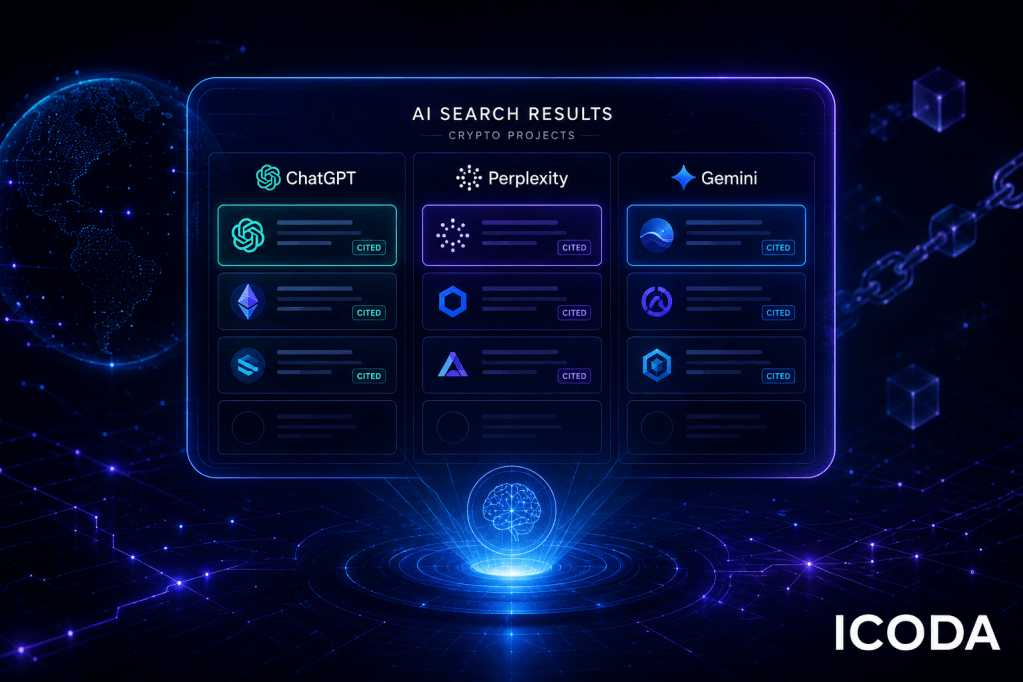
Think about how a user found your project two years ago. They typed a query into Google, scrolled past ads, found a blog post or CoinGecko listing, and eventually landed on your site. That journey still exists — but it’s increasingly bypassed. Today, that same user opens ChatGPT and asks: “What are the best DeFi platforms for yield right now?” The AI answers directly. No links to scroll through. No second chance. If your project isn’t in that answer, you’re invisible to that user — and your analytics will never tell you they were even looking.
The numbers confirm the shift. ChatGPT hit 900 million weekly active users by end of 2025, Perplexity reached a $20 billion valuation, and Claude became the choice of 60% of Fortune 500 companies. Globally, 1.2 billion monthly AI search users are conducting 2.5 billion daily AI interactions. Meanwhile, 58% of users have already replaced traditional search with AI tools for product and service discovery, and AI-driven traffic to websites grew 4,700% year-over-year by mid-2025.
For crypto projects, the consequences are acute and asymmetric. Less than 15% of crypto projects have taken meaningful steps to optimize for LLM visibility. Most haven’t even consulted a crypto advertising agency with AI SEO expertise — let alone built a systematic strategy. That gap is both the problem — and the opportunity.
Why Crypto Projects Are Especially Vulnerable
Crypto projects face a uniquely severe AI visibility problem: LLMs are structurally cautious about blockchain content, which means even strong projects get filtered out.
Most Web3 teams assume that if they rank on Google, they’re covered. They’re not. A project can rank #1 on Google for “best Solana developer tools” and still not appear in a single AI answer for the same query. Traditional SEO and AI search visibility measure entirely different things.
The problem compounds for crypto specifically. Large language models are trained to be risk-averse about financial and blockchain content — flagging it as speculative, regulatory-adjacent, or unverified. Without strong third-party signals, structured authority, and consistent entity-level references across the web, even technically excellent projects get filtered out of AI-generated answers.
A 2025 study across TON ecosystem DeFi protocols found that ChatGPT failed to mention any of them in 87% of DeFi-related queries — despite those projects having strong Google rankings and genuine TVL. The problem wasn’t product quality. It was AI discoverability.
Here’s what most teams miss about why this happens:
- LLMs synthesize, they don’t rank. When a user asks ChatGPT “which DEX has the best UX,” the model isn’t returning a ranked list — it’s generating a confident answer based on what it knows. If your project isn’t embedded in its training data and real-time citation sources, it literally doesn’t exist in that response.
- The Reddit blind spot. According to a June 2025 analysis of over 150,000 LLM citations, Reddit was the single most cited domain across AI responses — accounting for roughly 40% of all citations, ahead of Wikipedia and YouTube. Reddit accounts for nearly 47% of Perplexity’s citations specifically. Most crypto teams have no authentic Reddit presence whatsoever. A thread discussing your DEX’s UX carries more weight in an AI response than your entire blog archive.
- The E-E-A-T gap. AI models weight content from sources that demonstrate real-world experience, expertise, and consistent third-party corroboration. Generic token descriptions and whitepaper summaries don’t qualify. Structured, specific, cited content does.
- The trust signal deficit. The names that show up in AI answers aren’t random — they’re chosen based on structured content, credible mentions, media coverage, and the data that large language models have been trained on. Crypto’s history of scams and rug pulls makes LLMs extra cautious about recommending blockchain projects without strong verification signals.
What AI Invisibility Is Actually Costing You
Every day your project is absent from AI-generated answers, a competitor with identical or inferior technology is capturing users who never find you.
The queries AI now answers are exactly the ones that drive decisions: “best crypto wallet 2026,” “top layer 1 blockchains,” “safest cross-chain bridge,” “best web3 infrastructure provider.” If your protocol isn’t in those answers, your competitor is.
The conversion math is what makes this especially painful. Users who arrive via an AI recommendation don’t browse — they’ve already been pre-qualified by the AI’s synthesis. 200 visitors from ChatGPT converted at 46%, while the same product’s Google traffic converted at just 29%. Same product. Same landing page. Completely different intent signal.
And the compounding effect is real. Projects getting cited consistently by ChatGPT are building a compounding advantage: every citation increases the likelihood of future citations. Brands that wait will face the same problem late-movers faced in traditional SEO — authority gaps that are hard to close once established.
The Anatomy of AI Search Visibility
AI visibility for crypto is built on three interconnected pillars: structured content, third-party citation authority, and entity-level brand signals.
Understanding what AI platforms actually use to decide whom to cite is the diagnostic starting point. Here’s what separates visible projects from invisible ones:
| Visibility Factor | What AI Systems Reward | Common Crypto Mistake |
| Content Structure | Question-answer formats, clear headings, FAQ schema | Whitepaper-style prose; marketing copy |
| Citation Authority | Multiple independent sources referencing the same entity | Owned channels only; no third-party press |
| Entity Recognition | Consistent brand name + descriptors across the web | Inconsistent naming; minimal off-site presence |
| Trust Signals | Regulatory mentions, audit reports, verified team info | Anonymous teams; unverified claims |
| Topical Coverage | Deep, specific content clusters on core use cases | Generic “what is DeFi” content |
| Community Signals | Authentic Reddit/forum discussions, user-generated content | Zero community content; no Reddit presence |
AI visibility measures two core metrics: brand mention rate (your name appears in the answer text) and domain citation rate (your URL is used as a source). These are distinct from traditional SEO rankings. You need to optimize for both independently. The right AI visibility tool tracks both signals simultaneously across platforms — most crypto teams are currently flying blind on at least one of them.
How to Fix It: The AI SEO Playbook for Crypto
AI visibility strategy for crypto requires a five-layer approach that builds LLM-readable authority from the technical foundation up.
This is where execution separates projects that get cited from those that don’t. The fix isn’t tweaking your blog. It’s a systematic rebuild of how your project is represented across the entire web — in a structure that LLMs can ingest, verify, and confidently synthesize.
Layer 1: Technical Foundation for LLM Ingestion Implement CryptoToken and Organization schema markup enriched with verifiable on-chain data. Optimize your robots.txt and sitemap.xml to prioritize AI ingestion of core documentation. Structure your technical docs, API references, and use-case explainers for direct AI agent parsing — not just human readers.
Layer 2: Content Restructuring for AI Answers Every key page needs to open with a direct, standalone answer to the question it addresses. Replace generic marketing language with specific, verifiable claims — measurable results, documented integrations, concrete comparisons. Build content clusters around the exact queries your audience asks AI tools: “best [use case] for [audience],” “how does [your protocol] compare to [competitor].”
Layer 3: Third-Party Citation Infrastructure A single company blog is not a citation source. AI systems need to see your project referenced consistently across independent, authoritative domains. This means strategic media placements in crypto-native and mainstream finance outlets, community building in forums that LLMs actually weight (Reddit is non-negotiable), and PR that generates durable, reusable mentions — not one-time news hooks.
Layer 4: Entity-Level Brand Building Your project needs to exist as a recognized entity in LLM knowledge graphs — not just as a URL. This means consistent name + descriptor patterns across all references (“[Project Name], a non-custodial DeFi lending protocol“), structured data that ties your token, team, audits, and ecosystem integrations together, and community content that reinforces your positioning from non-owned sources.
Layer 5: Monitoring and Iteration AI visibility tracking covers ChatGPT, Perplexity, Gemini, Copilot, Google AI Mode, and Grok. Two core metrics define it: brand mention rate and domain citation rate. A dedicated AI visibility tool makes it possible to benchmark where you stand today, track citation changes over time, and connect AI-referred traffic directly to revenue outcomes — not just impressions. Without this feedback loop, you’re optimizing blind.
AI visibility strategy for crypto follows the same principles applied across other industries through LLM marketing practice STIVE — structured content, third-party citations, entity-level brand building. The difference is that crypto requires an extra layer of trust signals, since LLMs are notoriously cautious about blockchain content. That’s exactly the gap ICODA was built to close.
Proof It Works: From Invisible to AI-Endorsed in 90 Days
ICODA‘s AI SEO campaigns have delivered 1,400% traffic growth and 688% ChatGPT citation growth for crypto clients — with AI-referred users converting at nearly twice the rate of Google traffic.
The prop trading case study is instructive. The client was an international crypto prop trading company facing strong competition from established firms with aggressive PR, SEO, and community strategies, while also dealing with trust and reputation challenges common in the crypto trading industry. Their goal: dominate AI-driven search for commercial discovery queries — not just rank on Google.
The strategy combined classic SEO with AI-first visibility tactics, executed in monthly iterations with clear performance checkpoints. The brand secured long-term leadership in AI-driven search despite algorithm volatility — including surviving the Google December 2025 Core Update, which heavily affected grey-niche and high-competition industries.
Another ICODA client achieved 688% ChatGPT traffic growth by becoming the authoritative source AI systems cite for crypto queries, while a separate campaign secured Top 2 AI visibility rankings on Ahrefs among all competitors. Their PR-as-infrastructure approach generates 200+ AI citations across platforms, transforming media placements into algorithmic leverage points.
The pattern across campaigns is consistent: structured content + citation infrastructure + entity optimization = compounding AI visibility. AI-referred users convert at a higher rate because they’ve already been pre-qualified by the AI’s response. The traffic is smaller in volume, but far higher in intent.
The Window Is Closing — But It’s Still Open
Early movers in AI search visibility are building compounding authority that will be nearly impossible to close once established — the same pattern that defined early Google SEO winners in crypto.
AI search has gone mainstream: platforms like ChatGPT, Google Gemini, Claude, and Perplexity are now powering 7.8% of global search traffic, with Google’s AI Overviews appearing in 13% of search queries — nearly double what was seen six months prior. This is not a future trend to monitor. It’s the current reality of how your audience discovers projects.
For crypto founders and CMOs, there’s one question that cuts through the noise: What do AI assistants say about your project right now?
If the answer is “nothing” — you have a defined, solvable problem. And the solution isn’t a tweak. It’s a systematic AI visibility strategy built specifically for blockchain, executed by a team that understands both LLM optimization and the unique trust challenges of crypto — and equipped with the right AI visibility tool to measure progress at every stage.
Take the Next Step
The only way to know where your project stands in AI search is to test it — and then build a strategy to close the gap.
For crypto projects:CODA offers a free AI visibility strategy session. As a specialized crypto advertising agency, the team has worked with 650+ blockchain clients including TON, BingX, and Filecoin, and has delivered verified AI SEO results across DeFi, trading, GameFi, and Web3 infrastructure. Start at icoda.io.
For brands in other industries: The same team runs STIVE — an LLM marketing platform built for non-crypto brands across SaaS, fintech, e-commerce, and beyond. See where your brand stands at stive.ai.
The question isn’t whether AI search matters for your brand. It already does. The question is whether you’re part of the answer — or whether your competitor is.




 PR Desk
You must be logged in to post a comment.