Dubai, UAE, March 5, 2026
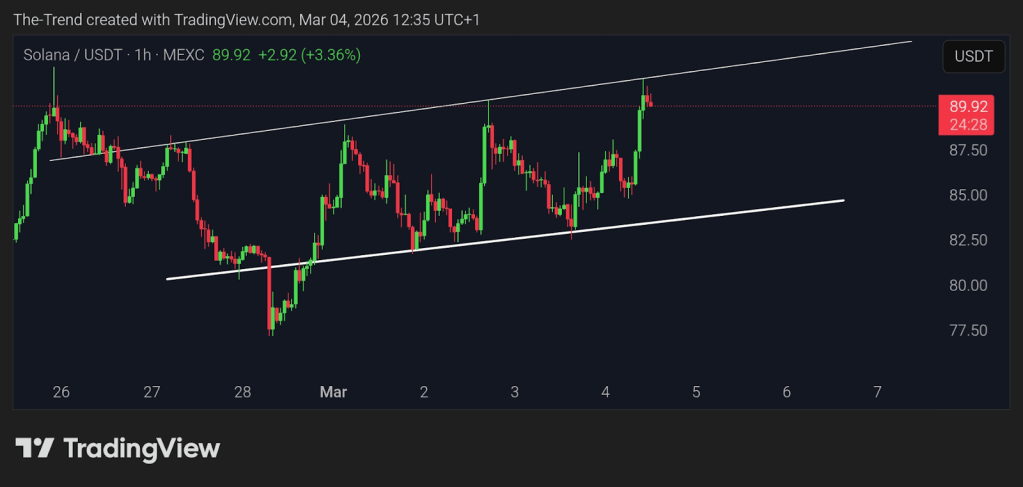
Solana holders are monitoring a key level on the four-hour chart as the asset enters a phase of short-term compression. SOL is trading near the $92 resistance zone following a modest rebound over the past 24 hours. This level has become a near-term decision point, with market participants watching for either a breakout that could extend upside momentum or a rejection that may push price back to $78. While SOL holders watch this technical structure, Mutuum Finance (MUTM) expands its presence in the market.

Solana in Consolidation
On the 4-hour timeframe, Solana remains range-bound between resistance at $90.68 and support at $76.66, with SOL trading around the $83–84 mid-range zone. The $90.68 level has faced multiple rejections, while buyers continue to defend the $76.66 support area.
For now, there is no confirmed trend, just a well-defined consolidation range. A decisive break above $92 would likely signal continuation to the upside, while a loss of $76.66 could open the door to a deeper downside rotation. Momentum remains neutral until one of these boundaries is clearly breached.
On the weekly timeframe, Solana is trading within a long-term rising channel that has been intact since 2020. Despite this recovery potential, Solana’s ROI potential remains capped by its large market cap. Meanwhile, Mutuum Finance (MUTM) is gaining attention in the DeFi market as it builds its non-custodial protocol.
Mutuum Finance Delivers Live DeFi Infrastructure
Mutuum Finance is a decentralized lending and borrowing project, whose V1 Protocol is now live on the Sepolia testnet. This deployment allows users to interact with core platform mechanics using test assets before mainnet launch. The testnet version supports lending and borrowing across four major test assets: USDT, ETH, LINK, and WBTC.
Participants can supply these test tokens to liquidity pools and receive mtTokens, which function as yield-bearing receipts that automatically accrue value as interest accumulates. The platform also includes an automated liquidation bot that monitors protocol health.
Blockchain security firm Halborn Security completed an independent audit of all lending and borrowing contracts before the testnet launch, with the team integrating all feedback. MUTM, the protocol’s native token, is priced at $0.04. Its holder count has surpassed 19,070, with more than $20,750,000 in funding. The token’s smart contracts are Certik-audited, achieving a 90/100 token scan score.
mtTokens Generate Passive Yield
When users supply assets to Mutuum Finance’s liquidity pools, the protocol mints mtTokens at a 1:1 ratio representing their deposit positions. These tokens automatically increase in value over time as borrowers repay interest, eliminating the need for manual yield calculations. For example, a participant supplying $5,000 in USDC to a lending pool could earn between 10-15% APY, depending on utilization rates. This translates to $500 to $750 in additional value annually.
Buyback-and-Redistribute Rewards
Mutuum Finance implements a buyback-and-redistribute model that directly benefits participants who stake mtTokens in the safety module. A portion of all platform revenue generated through lending fees enters the open market to purchase MUTM tokens. These purchased tokens are then redistributed to stakers, creating ongoing rewards for those contributing to protocol security.
For instance, if the platform generates $500,000 in annual fees and allocates 20% toward buybacks, $100,000 worth of MUTM would be distributed among stakers. Unlike simple buy-and-burn approaches that permanently remove tokens, redistribution ensures active participants capture ongoing value from platform growth.
MUTM, the native token of Mutuum Finance, is currently priced at $0.04. The protocol has undergone a security audit and provides a functional testnet version of its platform. These components reflect its infrastructure-focused development approach. While traders in the Solana ecosystem monitor key technical levels such as the $76 range, users assessing Mutuum Finance can access its testnet to examine its lending and borrowing mechanisms and overall functionality.


 PR Desk
You must be logged in to post a comment.